

Egypt’s central bank raises inflation outlook to 16%–17% on energy shock risks
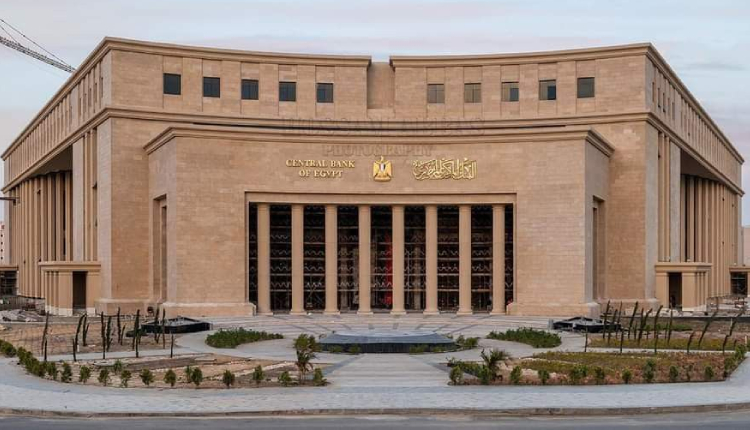
Egypt’s central bank raised its inflation outlook for 2026 and 2027, citing persistent energy market disruptions and currency pressures linked to geopolitical tensions, according to its Monetary Policy Report released on Monday.
The Central Bank of Egypt (CBE) now expects annual headline inflation to average 16.0 per cent in 2026 and 12.0 per cent in 2027 under its baseline scenario, up from 11.0 per cent and 8.0 per cent, respectively, in its previous quarterly report.
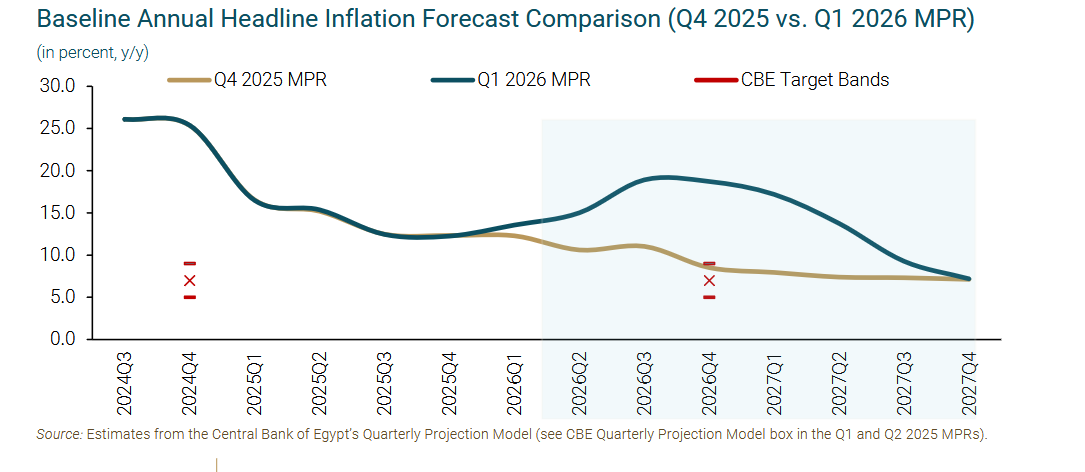
Under an alternative scenario in which the Iran–US conflict persists through end-2026, the central bank said that inflation would average 17.0 per cent in 2026 and 13.0 per cent in 2027 before easing towards single digits in the second half of 2027.
“Compared to the Q4 2025 MPR, the outbreak of the Iran–US conflict has created a shift in the inflation outlook, leading to an upward revision of the forecast,” the CBE said.
The central bank attributed the revision to a global energy price shock and stronger-than-expected risk aversion in international markets, alongside exchange-rate volatility and fiscal consolidation measures that include domestic energy pricing adjustments.
It said inflation readings for March and the first quarter of 2026 came in above earlier expectations.
Under the baseline scenario, the CBE assumes the conflict will be resolved by the end of the second quarter of 2026, allowing energy markets to normalise and maritime flows through the Strait of Hormuz and Suez Canal to recover gradually.
Even in that case, inflation is expected to accelerate in the second quarter, remain elevated through 2026, and begin to ease from early 2027. The bank also said inflation is likely to remain above its 7 per cent ±2 percentage point target band in the final quarter of 2026.
Risks remain tilted to the upside, the CBE said, pointing to the possibility of prolonged geopolitical tensions, sustained energy price pressures, and stronger pass-through from fiscal consolidation measures.
It also warned that global inflation risks are skewed higher due to energy costs, with potential spillovers into food prices, freight insurance premiums, and fertiliser markets.
Tighter financial conditions in advanced economies could also weigh on capital flows to emerging markets if major central banks reverse monetary easing, it added.
Attribution: Amwal Al Ghad English