

Hania Mohamed Mostafa: Redefining Success beyond Banking and Titles

The story did not begin with a vague dream or a sudden desire to break the rules. It began on a clear, straight path — one that felt reassuring, met expectations, and was socially defined as “the right path.” From her earliest years, my daughter was different in her quietness and in the way she perceived the world. She possessed an early analytical mind, a deep sense of discipline, and a remarkable ability to focus and persevere. She chose to study Finance not because it was easy or popular, but because it suited her nature — a field that demands precision, structure, and long-term patience.
She pursued Finance as a full academic discipline, then continued her studies until earning her Master’s degree from Kingston University in England, graduating among the top of her class. Her excellence was not momentary but progressive — a steady ascent that allowed her to complete her academic journey at a very young age. She earned her Master’s degree at around twenty-one years old, the result of academic brilliance and an accelerated educational path. At that stage, she already possessed what many spend years striving to achieve: solid knowledge, a strong qualification, and a clear vision of the future.
At that time, her ambition was unmistakably defined. She saw herself in the world of major financial institutions, particularly commercial and investment banks — a structured environment governed by strict rules, clear career paths, and social prestige. This ambition was grounded in real merit, and opportunities followed accordingly. Offers came from leading banks, with strong titles, respected positions, and monthly incomes reaching tens of thousands in value. From the outside, the picture seemed complete: a high-achieving young woman, educated abroad, with a secure future and professional stability many aspire to.
She entered that world, worked within it, and succeeded. She performed with efficiency, understood numbers deeply, and moved confidently within a system that rewards discipline. Yet over time, she discovered a truth that had not been apparent at first: money, no matter how important, does not answer every question. A prestigious job does not always provide a sense of true belonging. It was neither a rejection of success nor dissatisfaction with work, but a quiet inner realisation that there was a space this world could not reach, no matter how complete it appeared from the outside.
At the same time, another interest was slowly taking shape — without noise or declaration. It did not begin as a decision, but as observation. She watched the way working women dressed: tailored suits, precise cuts, clean lines — and how a thoughtfully designed garment could transform a woman’s presence. She understood that formalwear is not merely clothing, but a language — one that communicates strength, respect, and seriousness without sacrificing femininity or refinement. She noticed how clothing could alter posture, voice, and even how others perceive a woman.
Gradually, she realised that her true passion was not the job itself, but this parallel world. Fashion — not as a fleeting trend, but as a complete industry with its own rules, craftsmanship, and deep impact. This realisation did not arrive suddenly; it was the outcome of years of reflection, comparison, and silent observation. She came to understand that no matter how successful she became in finance, her heart would remain tied to a passion she could not initially name.
The decision was not easy. Leaving a secure path is far more difficult than starting from zero. Yet she chose honesty with herself. She did not approach fashion as a romantic dream or a temporary desire, but as a profession that requires real learning, patience, and respect for detail. She chose to begin from the inside, away from public visibility. She worked in several brand-building environments — sometimes without pay and sometimes for minimal compensation — not in pursuit of money, but mastery.
For years, she lived behind the scenes. She learned how a brand is born from an idea, how a sketch becomes a pattern, and how fabric transforms into a finished piece. She learned how to select materials, understand cuts, perfect finishing, control quality, and manage the small details that separate the ordinary from the exceptional. Those years were a quiet investment — demanding at times, but essential. Years in which she built herself before building a name, and learned that the true path cannot be shortened.
From this long accumulation of experience, her vision became clear. She did not want a general label or fast fashion. She envisioned a specialised brand that blends elegance with formality — one that speaks to young women at the beginning of their professional lives as they search for their first confidence, and equally to women with years of experience, for whom elegance becomes an extension of presence. She believed that a well-designed piece should not be confined to a single context, but move with a woman through the different stages of her life.
Designs suitable for work flowed seamlessly into cocktail settings and appeared with quiet sophistication at formal occasions. Clothing that lives with a woman rather than imposing itself upon her. Pieces that embody refinement, respect, and understated chic, carrying a distinct signature that reflects the identity of Egyptian girls and women of all ages. She did not want women to change themselves to fit the clothes, but to create clothes that serve women as they are — in both strength and calm.
From this philosophy, the brand AZALEIA was born. A name that reflects continuity, roots, and quiet femininity. A brand that is 100% Egyptian — in design, execution, and finishing. Egyptian craftsmanship that competes with major global names in formalwear, and perhaps surpasses them in understanding the real needs of working women in their authentic environments, without imitation or pretension.
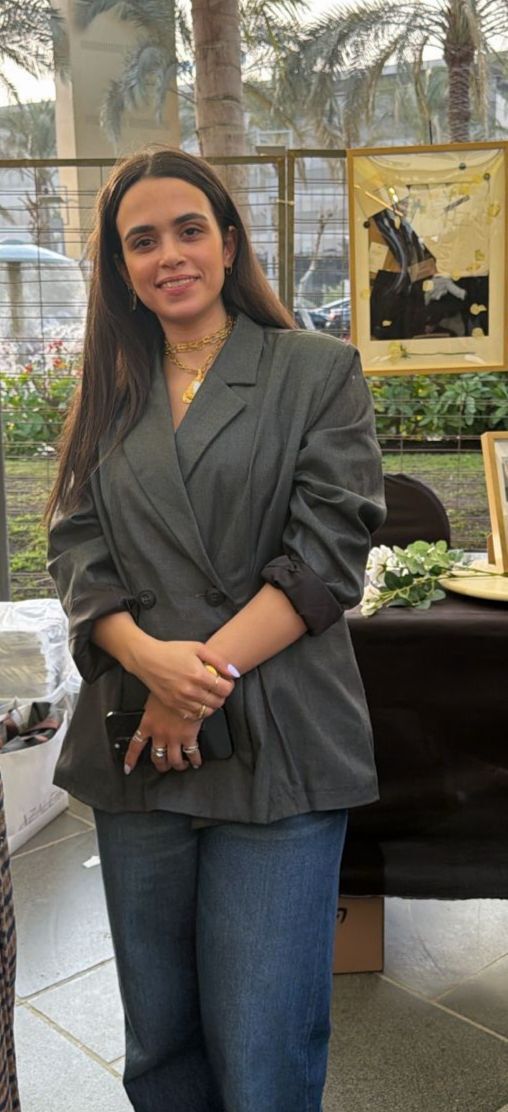
Last Saturday, she was no longer the girl learning in the shadows. She stood as one of the exhibitors with her own brand. AZALEIA pieces stood before people not merely as products, but as evidence of a long journey of conscious choice, patience, learning, and temporary sacrifice. Every piece carries behind it years of unpaid work and a belief that true building takes time.
At this point, it becomes essential to define the story itself. This is not the story of a woman who has arrived, but of a young woman who is just beginning. A twenty-seven-year-old woman named Hania Mohamed Mostafa, who never confined herself to narrow frames or small dreams. From early on, she saw herself beyond the local market, beyond settling for what was available — even when the road appeared long.
Hania never dreamed of fame, but of standards. She envisioned herself one day exhibiting in global spaces such as Harrods and Selfridges — not as fantasy, but as a logical path built on craftsmanship, patience, and the belief that global reach does not mean losing identity, but standing firmly within it.
At the heart of this journey was a decision I renew every day: I never stood in her way, and I never told her “no,” out of fear, anxiety, or overprotection. I listened to her — not to correct her, but to understand her. I listened to what she wanted, what she believed in, and what felt true to her, even when the road seemed longer than expected.
I have always believed that real dreams are not measured by speed, but by sincerity — and that what requires time deserves time. I never rushed her, never demanded quick results, and never imposed a deadline on where she should be. Giving time, I believe, is itself an act of trust.
That is why I believe today more than ever that we must give girls time — time to think, to try, to fail, to learn, and to endure the paths they choose. Because trust is not built through pressure, but through space, and through faith that what a girl dreams of can indeed become real.
And I will continue to give her all the time she needs, without haste or fear, until she reaches what she wants — not what others want for her. Because true arrival is not about reaching quickly, but about arriving while still remaining ourselves.
Today, after seeing the result—AZALEIA standing on solid ground — with Egyptian design, refined craftsmanship, and a clear vision — I can say with confidence that the road to that dream is no longer distant. It is no longer an idea, but a defined path with steps and time. A dream measurable by work, not by wishes.
This is not a story about leaving banking, nor about comparing money to fashion. It is the story of a young woman who had every reason to stay on the safe path — yet chose the one that truly resembled her. A story of a girl who did not reject success, but redefined it. She did not escape knowledge; she used it. She did not abandon reason; she made it the foundation of creativity.
And this, at its core, is not the end of the story — but it is rather true beginning.