

Egypt’s central bank maps alternative inflation path on Iran-US conflict
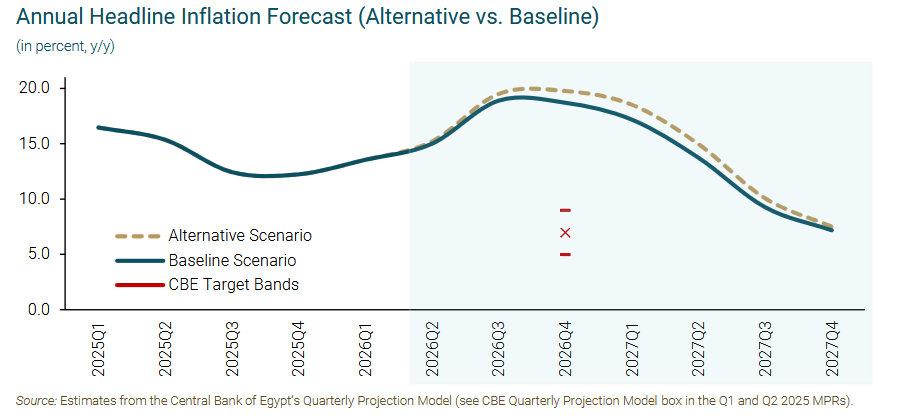
Egypt’s central bank raised its inflation outlook and outlined an alternative risk scenario after the Iran–US conflict triggered a surge in energy prices and intensified pressure on emerging markets, according to its Monetary Policy Report (MPR) released Monday.
The Central Bank of Egypt (CBE) said inflation projections had worsened compared with its fourth-quarter 2025 report because of what it described as “a global energy price shock and risk-off sentiment” that exceeded earlier assumptions.
“The outbreak of the Iran–US conflict has created a shift in the inflation outlook, leading to an upward revision of the forecast,” the central bank said, adding that exchange-rate volatility and domestic energy-price adjustments had also contributed to higher inflation readings in March and the first quarter.
Under its baseline scenario, the CBE assumes the conflict is resolved by the end of the second quarter, allowing the Strait of Hormuz to reopen, energy prices to normalise, and global risk aversion to gradually ease.
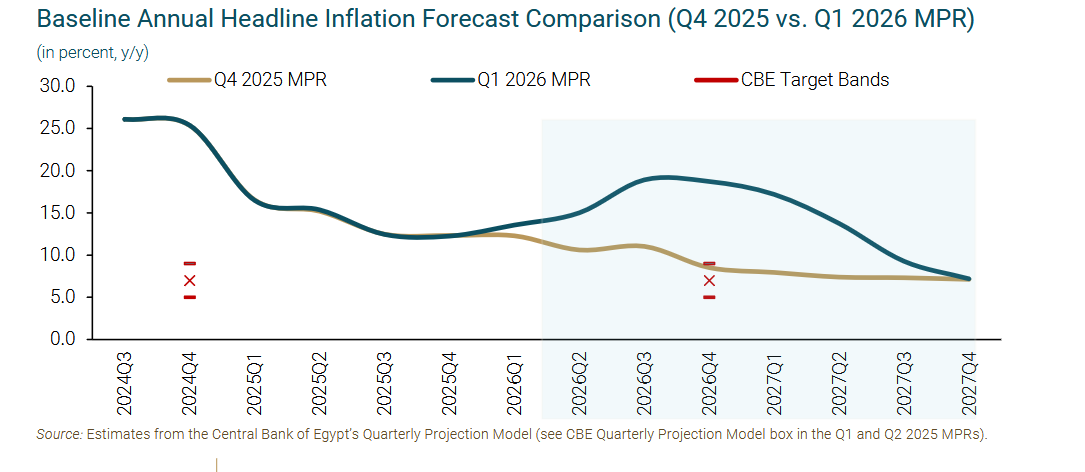
Even under that scenario, annual headline inflation is projected to exceed the CBE’s target of 7 per cent plus or minus 2 percentage points in the fourth quarter of 2026. The central bank now expects inflation to average 16 per cent in 2026 and 12 per cent in 2027, compared with previous forecasts of 11 per cent and 8 per cent.
The CBE said inflation is expected to accelerate through the second quarter, remain elevated during 2026, and begin easing from the first quarter of 2027.
“The baseline scenario envisages annual headline inflation returning to single-digit territory as of H2 2027.”
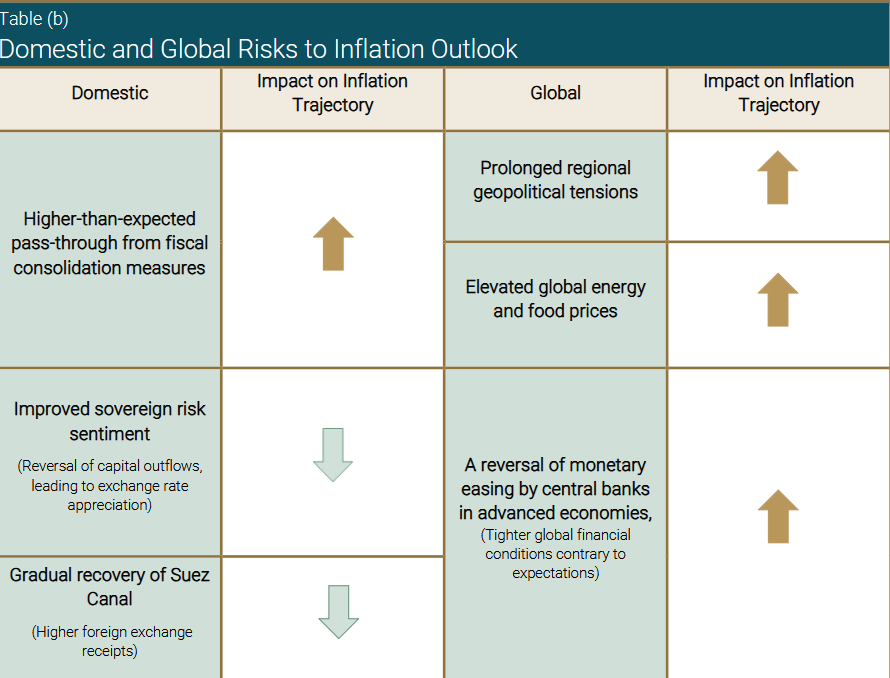
Still, policymakers warned that risks remain tilted to the upside, particularly if higher energy prices spill into food, transport, and fertiliser costs or if tighter monetary conditions in advanced economies weaken capital flows to emerging markets.
The central bank also outlined an alternative scenario in which the Iran–US conflict extends through the end of 2026, prolonging the energy shock and creating additional pressure on prices and the exchange rate.
“Under the alternative scenario, annual headline inflation is projected to accelerate throughout 2026 to higher levels compared to the baseline scenario, before gradually converging to single digits, on average, by H2 2027.”
According to the CBE’s alternative scenario, inflation would average 17 per cent in 2026 and 13 per cent in 2027 before gradually returning to single digits in the second half of 2027, assuming “a tighter monetary stance” than under the baseline outlook.
Attribution: Amwal Al Ghad English