

Egypt’s excess liquidity hits decade low – CBE
Excess liquidity in Egypt’s banking sector has plunged to its lowest level in over ten years, driven by a surge in government debt issuance, the Central Bank of Egypt (CBE) said in its quarterly Monetary Policy Report on Monday.
The sharp contraction highlights a tightening of domestic financial conditions as the state maneuvers to manage its fiscal requirements following the start of a monetary easing cycle last year.
The central bank said average excess liquidity declined to 134.7 billion Egyptian pounds in the first quarter, equivalent to 11.7 per cent of reserve requirements, down sharply from 828.5 billion pounds, or 90 per cent of reserve requirements, a year earlier.
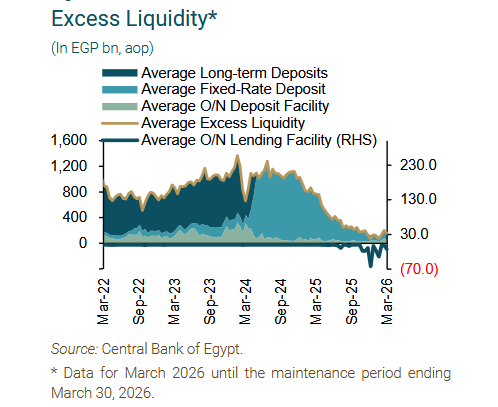
The central bank noted that this marks the lowest liquidity level since the fourth quarter of 2015, a shift it “mainly attributed to the net issuance of government securities.”
Interbank Market
The drop in excess cash has forced a change in how the central bank interacts with the interbank market. The CBE reported that it has stepped in to provide liquidity through overnight (O/N) lending facilities.
According to the the report, the contraction in liquidity was accompanied by an average O/N lending of 12.3 billion pounds in the first quarter of 2026. This represents a slight decline from the 15 billion pounds average seen in the final quarter of 2025, but remains significantly above “previously near-zero levels.”
The move reflects a strategic mopping up of liquidity to keep a lid on inflationary pressures while the government finances its deficit through local debt instruments.
Attribution: Amwal Al Ghad English