

Dangote Group eyes Egypt for next African industrial expansion
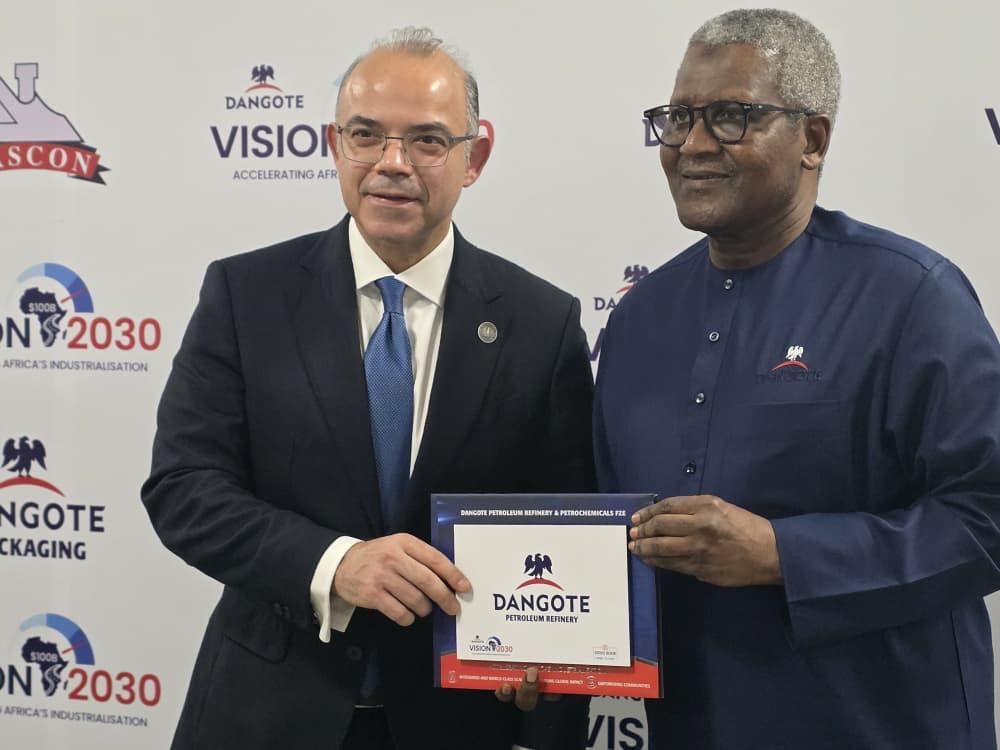
Nigeria’s Dangote Group is exploring opportunities to expand its industrial investments into Egypt, which it sees as its next destination for African expansion, the Egyptian investment ministry said, following talks with a high-level Egyptian delegation in Lagos on Sunday.
The delegation, led by Investment and Foreign Trade Minister Mohamed Farid, visited the Dangote Petrochemical Complex and met with the group’s President Aliko Dangote to discuss potential industrial partnerships and investment opportunities across several sectors, including oil refining, petrochemicals, and fertiliser production.
The discussions covered opportunities to expand production capacity and establish joint projects between Egyptian and Nigerian companies, drawing on the two countries’ industrial capabilities and competitive advantages.
The visit came as Dangote Group explores expansion opportunities in African markets, with Egypt emerging as a potential destination for future investments under its Vision 2030 strategy, which aims to expand its industrial presence across the continent and strengthen regional value chains.
It also follows remarks Dangote made in Cairo on 15 Oct., when he told an event hosted by the Egyptian Exchange (EGX) that he was sure Egypt would be part of the group’s planned $50 billion investment programme to industrialise Africa. At that event, Dangote said the group has a 10-year vision to process more of Africa’s natural resources locally and reduce reliance on imported finished goods, with plans spanning refining, fertilisers, cement, energy, and mining.
Farid said the Lagos visit aimed to translate diplomatic and economic engagement between the two countries into tangible investment opportunities and industrial partnerships. He said it followed previous meetings with the group, including discussions at the El Alamein Economic Conference and other international investment forums hosted by Egypt.
Farid said Egypt was keen to learn more about the group’s industrial capabilities in oil refining, petrochemicals, fertiliser production, and related industries to identify potential areas of cooperation.
“We were impressed by the scale of the industrial operations we saw, from refining and petrochemicals to fertiliser production,” Farid said. “Our goal is to identify areas where Egyptian and Nigerian companies can cooperate, expand industrial capacities, and create long-term value for both economies.”
He said private-sector cooperation should be central to the partnership, adding that combining the two countries’ strengths could expand industrial production, attract investment, and support sustainable economic growth.
The two countries have a combined market of around 400 million people, Farid said, while Nigeria’s energy resources and Egypt’s established industrial base offer opportunities for cooperation in manufacturing, energy, petrochemicals and fertilisers.
He added that stronger cooperation could encourage Nigerian companies and industrialists to expand in Egypt while giving Egyptian businesses opportunities to increase their presence in Nigeria. The potential benefits extend beyond trade and investment to include job creation, technology transfer, skills development, and the growth of supporting industries, he said.
Asked whether Egypt would welcome an investment by Dangote in an oil refinery, Farid said potential cooperation was not limited to refining.
“Investment does not necessarily have to be in an oil refinery; there are many sectors where we can cooperate,” he said in a ministry statement. “What matters most is building a partnership that creates added value for both countries and for Africa as a whole.”
Representatives of Egypt’s Ministry of Petroleum and Mineral Resources, led by Minister Karim Badawi, highlighted opportunities in value-added industries, particularly refining and petrochemicals. They cited Egypt’s infrastructure, ports, storage facilities, and capacity to transport and handle petroleum products as advantages for potential projects. The delegation also pointed to opportunities to use advanced technologies to produce high-quality products for the domestic market and for export to European and other international markets.
Dangote described the visit as reflecting the potential for greater economic integration across Africa and reaffirmed the group’s commitment to supporting industrialisation and economic development across the continent. He said expanding African companies’ investments across the continent was important to accelerating industrial development, and that the visit provided an opportunity to showcase the group’s industrial capabilities and discuss ways to strengthen production capacity in both countries.
Dangote said Egypt was the group’s next destination for expansion in Africa, according to the ministry’s statement. Neither the ministry nor the group has announced specific projects in Egypt or said how much of the planned $50 billion could be directed to the country.
The Egyptian delegation included officials from the Ministry of Petroleum and Mineral Resources, the General Authority for Investment and Free Zones (GAFI), the Egyptian General Petroleum Corporation (EGPC), the Egyptian Petrochemicals Holding Company, and the Sovereign Fund of Egypt (TSFE).