

The Shield Against Spoilage: How Peaceful Nuclear Technology Safeguards Food Security
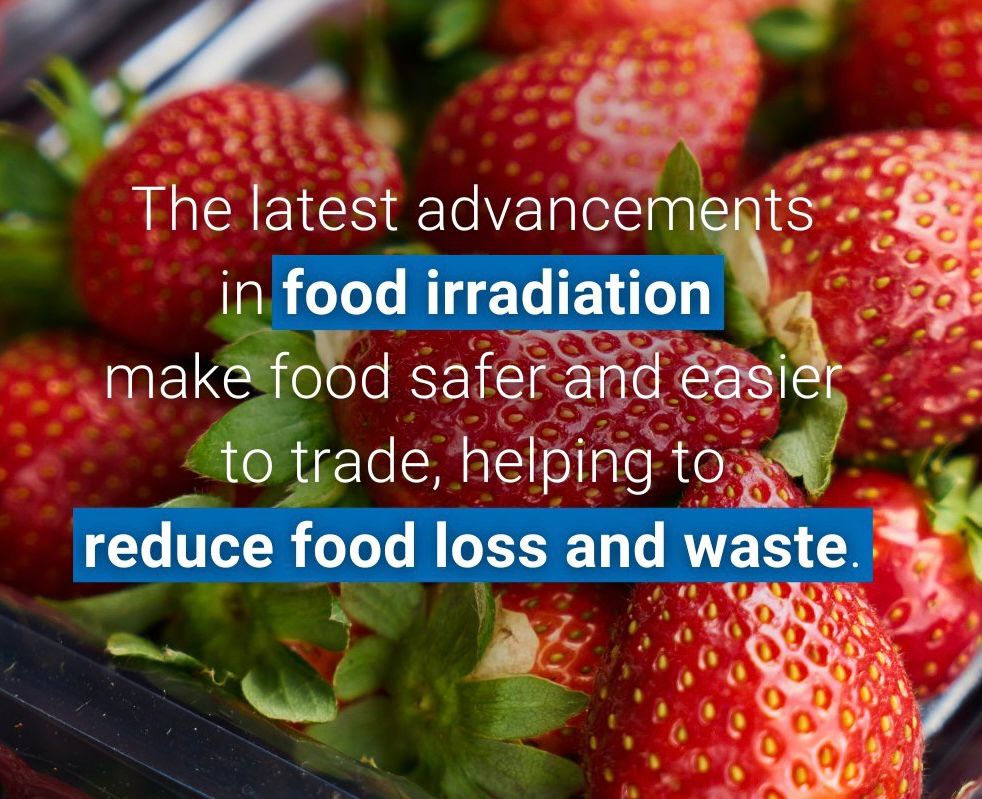
Agriculture remains one of Egypt’s greatest strategic assets. It feeds the nation, sustains millions of livelihoods, supports a thriving food industry, and positions the country among the world’s leading exporters of citrus, potatoes, onions, grapes, strawberries, herbs and other high-value crops. Yet one of the sector’s greatest challenges begins not in the field, but after the harvest.
Food loss is far more than a food security concern; it is an economic one. Every shipment lost to spoilage represents reduced income for farmers, wasted water and energy, higher logistics costs, lower export revenues and increased pressure on supply chains. According to FAO-related estimates, post-harvest losses in Egypt range from 15% to 45%, with fruits and vegetables among the most affected commodities.[1] At a time when global food demand is rising and export markets are becoming increasingly competitive, preserving agricultural value has become just as important as increasing production.
This is where peaceful nuclear technologies offer an often-overlooked solution. Food irradiation has been safely used for decades and is recognised by the International Atomic Energy Agency (IAEA), the Food and Agriculture Organisation (FAO) and the World Health Organisation (WHO) as an effective technology for improving food safety and reducing post-harvest losses.[2] Using carefully controlled doses of ionising radiation, it eliminates harmful microorganisms and insects, delays ripening and sprouting, and extends shelf life without making food radioactive or affecting its nutritional value.
The economic implications are significant. Depending on the product and irradiation dose, shelf life can increase by two to ten times, pathogenic microorganisms can be reduced by up to 99%, and post-harvest losses may decrease by as much as 90%.[3] [6] Because irradiation is a cold process, it preserves the natural taste, texture and aroma of food while eliminating the need for many chemical treatments, allowing producers to deliver safer products to consumers with minimal environmental impact.
For Egypt, these advantages are particularly relevant. The country already possesses valuable expertise in radiation applications, including food irradiation and sterilisation. The opportunity today is not to introduce an unfamiliar technology, but to modernise existing capabilities and integrate them more effectively into agricultural production, food processing, retail and export logistics. Doing so would strengthen the competitiveness of Egyptian agricultural products while supporting the broader objectives of Egypt Vision 2030, including food security, sustainable economic growth and export diversification.
The contribution of peaceful nuclear technologies to agriculture extends well beyond preserving harvested crops. Radiation-based applications such as the Sterile Insect Technique (SIT), developed under FAO and IAEA programs, help control agricultural pests by releasing sterilised male insects into the environment, reducing pest populations without relying heavily on chemical pesticides.[7] Together, irradiation and SIT demonstrate how nuclear science can support agriculture throughout the entire value chain, from protecting crops in the field to preserving their quality after harvest.
International experience illustrates the economic impact of these technologies.
In India, irradiation became a turning point for mango exports after the country adopted the technology to satisfy United States phytosanitary requirements, reopening access to one of the world’s most valuable markets.[4] South Africa has similarly integrated food irradiation into its national food safety framework, operating regulated irradiation facilities that support agricultural exports while also serving healthcare and industrial applications.[5] These examples show that irradiation is not simply a preservation technique; it is an instrument for strengthening international competitiveness.
Russia has taken this concept a step further by developing multipurpose irradiation centres that serve several industries simultaneously. Beyond food preservation, these facilities support healthcare through the sterilisation of medical products, manufacturing through industrial processing, and scientific research through specialised laboratory services. Their value lies in creating infrastructure that benefits multiple sectors rather than addressing a single challenge.
This integrated philosophy is reflected in Rosatom’s approach to irradiation technologies. As one of the world’s leading nuclear technology companies, Rosatom has developed comprehensive expertise covering the entire lifecycle of multipurpose irradiation centres, from engineering and equipment design to radiation safety systems, laboratory support, personnel training and long-term operational services. The company also develops both gamma irradiation and electron beam technologies, allowing countries to deploy solutions that best match their industrial priorities and processing needs.
Rosatom’s capabilities extend beyond engineering alone. As one of the largest producers of cobalt-60, the isotope widely used in gamma irradiation, the company combines isotope production, technology development and operational expertise within a single ecosystem. This integrated approach strengthens the long-term sustainability of irradiation facilities while supporting knowledge transfer, operational reliability and local capacity building.
For Egypt, such infrastructure could generate value well beyond agriculture. Modern irradiation centres can contribute simultaneously to food safety, export growth, healthcare, pharmaceutical production, industrial sterilisation and scientific research, reinforcing national resilience while supporting economic diversification. In this context, peaceful nuclear technologies become not merely scientific tools but strategic enablers of sustainable development.
Ultimately, the conversation is no longer about producing more food alone. It is about preserving more of what is already produced. In an increasingly competitive global economy, agricultural success is measured not only by the size of the harvest but by how efficiently it reaches consumers and international markets.
For Egypt, irradiation centres therefore represent far more than technical facilities. They are part of the infrastructure of a modern agricultural economy, helping farmers retain the value of their crops, enabling exporters to reach more distant markets, reducing waste throughout retail supply chains and providing consumers with safer food. In a future where food security, sustainability and competitiveness are inseparable, the greatest harvest will not necessarily be the largest, but the one that preserves its value from the field to the table.
Reference:
[1] FAO is closing the Food Loss and Waste Reduction project with a call for sustained efforts to eradicate hunger | United Nations in Egypt
[2] Making Fruit and Vegetables Last Longer with Food Irradiation | International Atomic Energy Agency
[3] Rosatom Presentation – Marketing
[4] Irradiation Opens the Door for Indian Exports
[5] Guidelines for monitoring irradiated foodstuffs in South Africa
[6] Rosatom Presentation – Marketing