

AI may reshape work more than eliminate jobs, McKinsey says
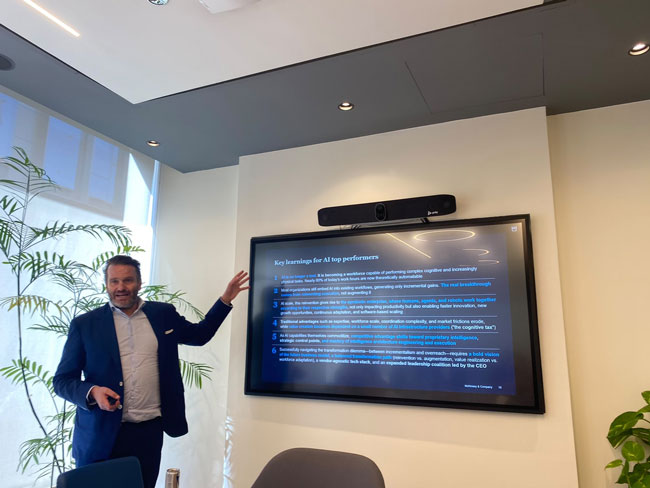
Artificial intelligence could automate as much as 57% of tasks performed by companies, but its bigger economic impact may come from reshaping work and boosting productivity rather than eliminating jobs, as AI becomes “part of the workforce,” a McKinsey senior partner said Thursday.
Johannes-Tobias Lorenz, Senior Partner at McKinsey, said the rapid development of agentic AI is changing the role of the technology from a tool that assists employees into systems that can perform tasks and solve problems with limited human intervention.
AI is “no longer a tool,” Lorenz said during a media roundtable in Cairo.
In the early days of generative AI, employees would ask a model for an answer and use the output in their daily work. Newer agentic systems can instead allow groups of AI agents to perform tasks and solve problems among themselves, with humans supervising the process, he said.
“But really becomes part of the job family, becomes part of your workforce,” Lorenz said.
From tasks to jobs
The distinction between tasks and jobs is becoming increasingly important as companies assess the economic impact of AI.
McKinsey research shows that 57% of tasks performed in companies could at maximum be automated, Lorenz said. That does not translate into 57% of jobs disappearing because most jobs comprise multiple tasks.
“This does not mean that 57 % of jobs become redundant because one job encompasses or includes many different tasks,” he said.
The more significant change may be in how individual jobs are structured, with AI taking over some tasks while employees spend more time on activities that require human judgement, interaction, or oversight.
Lorenz said companies should therefore view automation less as a headcount-reduction exercise and more as an opportunity to increase the amount of output they can generate from their existing workforce.
“… you wouldn’t say that it’s a job reduction effort but maybe a productivity increase that you can use either for higher service to our customers or to invest in further growth,” he said.
That productivity dividend could take different forms, including better customer service, additional investment, or the ability to expand without increasing the workforce at the same rate.
AI as a response to shrinking workforces
The implications are particularly significant for economies facing demographic pressure, Lorenz said.
Europe, where populations are ageing and workforces are contracting, could use AI to compensate for workers leaving the labour market through retirement.
“We in Europe, with a declining population, can say we use it more strongly to replace people who retire and really help us, because of having this baby boomer cliff. The workforce is really contracting, and so AI can be super helpful in bridging that quality gap,” Lorenz said.
In that scenario, AI would not necessarily displace workers on a one-for-one basis. Instead, it could help companies maintain production and services as fewer people are available to perform the same volume of work.
That could also change the economics of hiring, with companies increasingly weighing the cost of human labour against the ability of AI agents to perform specific tasks.
The rise of the AI workforce
The transition to agentic AI could accelerate that shift because companies will no longer be using AI only as software that employees consult.
Instead, AI agents can increasingly be assigned tasks, coordinate with one another, and operate within business processes, while humans remain responsible for supervision and higher-level decisions.
That creates what Lorenz described as a symbiotic organisation, in which employees and AI agents work together, and companies determine how responsibilities should be divided.
The challenge will be establishing the right mechanisms for coordination, supervision, and alignment between humans and agents, he said.
Jobs will need to be rethought
The emergence of AI also means companies will need to rethink the design of jobs and business processes rather than simply automate existing workflows, Lorenz said.
Companies that gain the most from AI are stepping back and asking what customers need, what their products and services should look like, and how the underlying processes should be redesigned.
By contrast, companies that simply take an existing workflow and replace individual steps with AI tools risk capturing a smaller share of the potential productivity gains.
Lorenz said the difference is between using AI within an existing job and rethinking the job itself around what humans and AI can each do best.
“The same as AI is no longer a tool, but part of the workforce is also a tool how you should think about reinventing and rethinking your business processes,” he said.
That shift could make AI less about replacing entire occupations and more about changing the composition of work, automating selected tasks while allowing employees to focus on higher-value activities.
The productivity question
For companies, the ultimate test will be whether the technology produces enough additional output to justify the investment.
Lorenz said the strongest AI performers are not simply those deploying the most tools, but those redesigning their organisations around the technology and finding ways for humans and AI agents to complement one another.
That could make productivity, rather than job cuts, the more important measure of AI’s economic impact.
As AI moves deeper into business operations, the question for executives may therefore shift from how many workers the technology can replace to how much more their workforce can accomplish with AI embedded in the job itself.