

McKinsey says AI could compress decades of Egypt’s economic development
Artificial intelligence and the digital economy could help Egypt compress decades of economic development into a far shorter period, senior McKinsey & Company executives said at a media roundtable in Cairo on Thursday. They stressed that capturing the opportunity will require heavy investment in computing capacity, energy, and connectivity, along with new skills and ways of working.
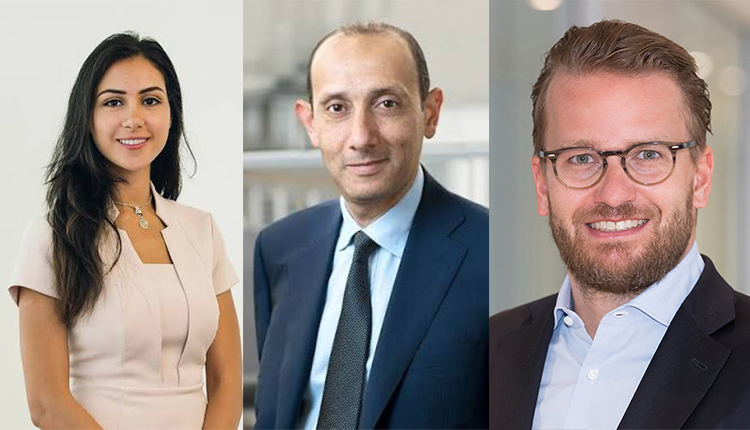
Tamim Saleh, Senior Partner and Managing Partner of McKinsey’s Cairo office, said the country may be nearing an inflection point. He spoke alongside Johannes-Tobias Lorenz, a Senior Partner, and Noura Selim, a Partner, at the firm’s Cairo headquarters, where selected Egyptian journalists were invited. The event followed a digital summit McKinsey held in Cairo on Wednesday.
“Is there an inflection point? Perhaps the rules of the game change for accelerating growth,” Saleh told reporters.
Decades, not years, for past success stories
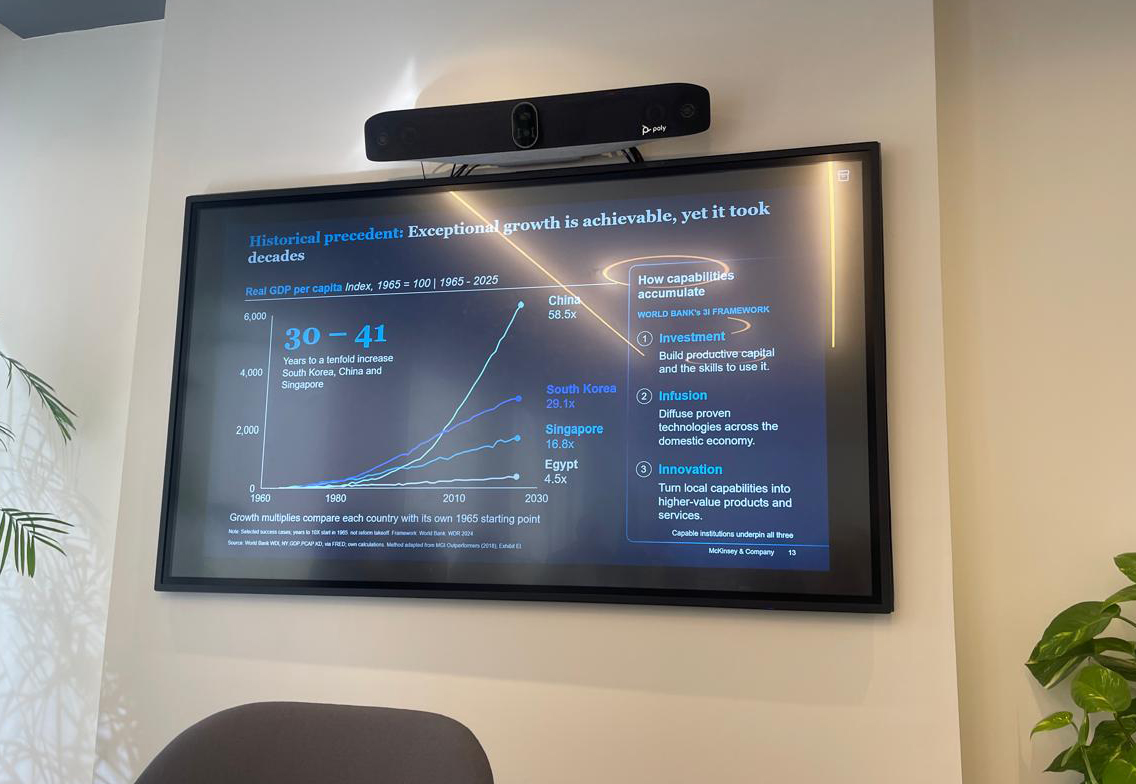
Saleh said even the most celebrated development stories took generations. He cited China, South Korea, and Singapore, which needed years of investment to build productive capital, attract foreign and domestic capital, spread new technologies and develop local innovation capacity.
He noted that South Korea was among the world’s poorest countries by GDP per head 50 years ago, and that China’s economy grew roughly 58-fold from the 1960s. Egypt’s growth, he said, has been slower than he would like, at around 4 per cent or less.
“But perhaps the rules of the game change,” Saleh said, pointing to the speed at which AI is developing and spreading. He noted that expectations for the arrival of advanced AI have shortened sharply in a few years.
“If we really can produce generative AI and agentic AI that can dramatically improve productivity, why wouldn’t we think of much faster growth?” he said.
Beyond an export industry
Saleh stressed that the “Egypt moment” he outlined at Wednesday’s summit is not only about earning foreign currency from AI services. The larger prize, he said, is productivity gains across the wider economy as activity such as banking, education and research and development moves online.
“If we are moving to a digital economy and technology can accelerate productivity, then can that tech economy compress generations of development?” he said.
He said digitisation of government and business procedures could cut paperwork and the need to complete transactions in person. He pointed to electronic know-your-customer (e-KYC) rules, which let banks onboard customers digitally, as one example. Saleh acknowledged that only a limited share of companies currently see measurable value from AI, but said he expects that to rise as firms gain experience.
Compute, cloud, and energy
Saleh said Egypt must clear basic infrastructure hurdles first: investment, reliable connectivity, trusted computing capacity, and energy supply.
“We must have a sovereign cloud. We must have big compute capacity. We cannot afford not to have compute supported by the energy supply,” he said.
He said data cleansing and integration, large language models, and agentic AI are layers that build on one another, so the investment is not a one-off. Data quality matters, he added: agents run on poor data will produce poor results, and companies should treat their proprietary data as a differentiator.
Saleh said the prospect of data-centre expansion was among the most significant developments discussed at the summit. Foreign companies are looking at Egypt for data centres and software development, he said, and Egyptian firms are moving too.
“There are several great Egyptian companies, and we said we are building data centres. It was wonderful to hear that there is a movement now happening,” he said.
He recounted a summit panel in which an Egyptian executive argued that the country could reach significant scale in data, compute, and cloud within four years. The executive pointed to expected shortages of computing capacity and power in Europe, and to estimates that about 17 per cent of global data flows pass through Egypt.
“Of course, we will build data centres not just to supply Egypt but to be an exporter and bring billions of dollars,” Saleh said, recounting the discussion.
Asked about the climate impact of AI, Saleh said the grid must be reliable, stable, and competitively priced, and that the renewable share of the energy mix must keep growing. This is not only about emissions, but he also said: investors with global supply chains face Scope 3 emissions requirements, and “they will go elsewhere” if Egypt lags. He named Morocco as a competitor that has invested in renewables. He called the Dabaa project good news but said Egypt needs “to push and push and push.”
Why culture and process may matter more than technology
Asked about the shift from generative AI to agentic AI, Saleh said the largest barriers are human rather than technical. He cited research McKinsey published in the Harvard Business Review about six years ago, which he said found that more than 70 per cent of transformations struggled because of culture rather than technology.
He said simply automating existing processes with AI agents typically yields a 10 to 20 per cent improvement. Larger gains come from redesigning work with people at the centre of a new process, he said, but that requires people to work differently.
Saleh listed four constraints on adoption: a shortage of people who can build and manage agents, the need for new processes, data readiness, and infrastructure. He said generative AI and agentic AI face similar challenges, noting that agents are themselves created with generative models. He expects generative AI uses such as automated contracts and credit letters to spread faster in the near term.
Lorenz said cultural factors differ by region. He said that during recent visits to Hong Kong and Singapore, managers described difficulty adopting generative AI because it requires pushing decision and budget authority down from senior management to middle management.
“I perceive this culture here as way more entrepreneurial and driving. So, this could actually be an advantage,” Lorenz said of Egypt.
“It’s an advantage for Egypt,” Saleh replied, adding that people at the summit had said “we as Egyptians always find a way.”
Talent and cost competitiveness
Saleh described Egypt’s talent pool as a major advantage.
“We are blessed with talent,” he said. Technology, he added, now lets young Egyptians serve clients anywhere in the world. “If you are a 21-year-old Egyptian or an 18-year-old and you have a great idea, the world is your oyster.”
He said international companies operating in Egypt have come to recognise the productivity and work ethic of Egyptian staff. Visiting the digital factories McKinsey has built for clients in Egypt, he said, he met young engineers and data scientists who think differently and “explore and use the tools.”
Saleh said McKinsey analysed the full cost of technical roles, including software development, data engineering, product management for digital, and data science. Egypt was more cost-competitive than comparison markets at every experience level from fresh graduate to six years, he said, and scored well on quality. He said a large Indian company, introduced to McKinsey by colleagues in India, is considering building an IT centre in Egypt because of the cost advantage, something he said he “would have never imagined.” He did not name the company.
McKinsey said it is accelerating investment in an AI delivery hub in Cairo, anchored by its QuantumBlack AI unit. The hub will serve clients in Europe, the Gulf, and the wider Middle East, Egypt and parts of Africa. Saleh said it is about quality, not just cost.
Selim called the investment significant for the firm, which has set up similar hubs elsewhere. She said it reflects “a belief in talent” and in Egypt’s ability to serve markets such as the Gulf Cooperation Council states and Europe at the required quality.
Selim said realising the ambition for exports and foreign-currency earnings depends on a wider “ecosystem play.” That includes sufficient power, data centres, sovereign cloud, and supportive regulators, she said, adding that much is moving in the right direction but Egypt must ensure it is not constrained. She referred to a government goal of tripling exports by 2030 and said officials appear to understand this requires investment in sovereign cloud and in training young talent.
She said Egypt should move beyond lower-value outsourcing such as contact centres and technical business process outsourcing towards higher-value, AI-enabled services, given its talent, costs, and proximity to Europe.
Lorenz said he had discussed the same risk with companies in China and India, where classical outsourcing could shrink as automation spreads. Countries that can offer AI-enabled processes can keep winning work and raise the value added they deliver, he said.
Early momentum in banks, factories, and telecoms
Saleh said the number of Egyptian companies using generative AI to create value has grown considerably over two years. He described “green shoots” in banking, manufacturing and telecoms, including one or two manufacturers that have hired 50 to 60 data scientists to build factory-floor use cases that did not exist 12 months ago.
Capital and government backing
Saleh said raising capital will remain central if Egypt is to speed up technology-led growth, including finance for firms that struggle to scale because of collateral constraints. He said foreign companies are showing growing interest in investing in the technology ecosystem, from data centres to software development, and that recent weeks have brought a run of announcements and agreements involving Egyptian firms.
“Things are happening,” he said, adding that Egyptian companies are acting and signing deals on technology and digital infrastructure. He said the CEO of one leading company who spoke at the summit was already in talks with partners.
Official backing is another factor, Saleh said, describing encouragement for digital transformation that comes “from the top” of government. He said the combination of private investment, state support, infrastructure, and Egypt’s young workforce could create conditions for markedly faster growth.
He also warned of urgency. “We also have a window,” he said, adding that many summit participants had stressed Egypt must move fast because competitors will take the space if it does not, particularly in supplying Europe.
Can technology change Egypt’s growth path?
The central question, Saleh said, is whether these factors can change the pace of Egypt’s development. Rather than continuing at around 4 per cent or less, he asked whether Egypt could have a decade of much faster expansion, as AI and digital tools lift productivity.
The aim, he said, is not simply a bigger technology sector. A data-centre and AI industry could also serve as an enabler for the rest of the economy, speeding digital adoption across sectors such as manufacturing, health care, education, and financial services.
If Egypt can expand computing and cloud capacity, attract technology investment, improve connectivity, secure reliable energy, and make use of its young talent at the same time, AI could become more than a new export line, Saleh said. It could enable a broader economic transformation and shorten a development timeline that took successful economies several generations.
“Insha’Allah, we will do it,” he said.