

EBRD sees Egypt growth at 4.6% in 2026, 5.0% in 2027

Egypt’s economy is forecast to grow 4.6 per cent in calendar 2026 and 5.0 per cent in 2027, with activity showing resilience despite the effects of the Middle East conflict, the European Bank for Reconstruction and Development (EBRD) said on Thursday.
The forecasts, included in the EBRD’s September 2026 Regional Economic Prospects, are 0.3 percentage point lower for 2026 and 0.1 percentage point higher for 2027 than its June estimates.
On a fiscal-year basis, Egypt’s economy is expected to expand 4.8 per cent in fiscal 2026 and 4.9 per cent in fiscal 2027, down 0.1 percentage point from the June forecast for 2026 and unchanged for 2027.
Egypt “showed notable resilience in the first half of 2026, despite the negative effects of the conflict in the Middle East,” the EBRD said.
Economic activity has remained resilient, supported by communications, trade and petroleum refining, while remittances and tourism receipts rose strongly in the first quarter of 2026, helping support external balances amid heightened regional uncertainty.
The EBRD expects growth to strengthen further in 2027, but warned of significant downside risks from regional instability, particularly its impact on energy markets and foreign investor sentiment.
Egypt completed the seventh review of its International Monetary Fund (IMF)-supported programme in July 2026, while international reserves reached record levels, the EBRD said.
However, fiscal pressures remain significant, with gross government financing needs estimated at around 50 per cent of GDP in fiscal year 2027.
“Where governments spend a large share of revenue on debt servicing, tighter global financing conditions translate more strongly into higher government spending further raising government financing needs,” the EBRD said.
“In the EBRD regions, fiscal space is most limited in the southern and eastern Mediterranean and sub-Saharan Africa, where debt-to-GDP and interest-to-revenue ratios were already high,” it added.
“Interest payments absorb 88% of government revenue in Egypt and more than a fifth in Kenya, Nigeria, Ghana, Senegal, and Jordan,” the EBRD said.
Regional Economic Prospects September 2026 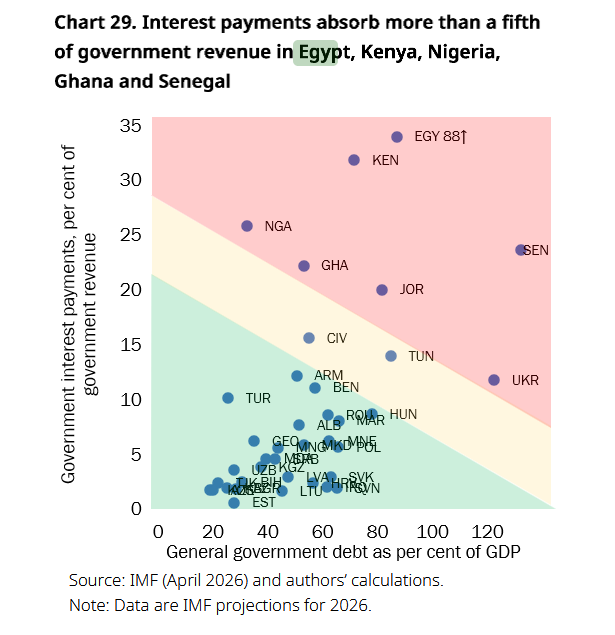
The EBRD also said the currencies of Türkiye, Egypt, and Romania weakened against the US dollar, with the depreciation partly improving cost competitiveness while adding to inflationary pressures.
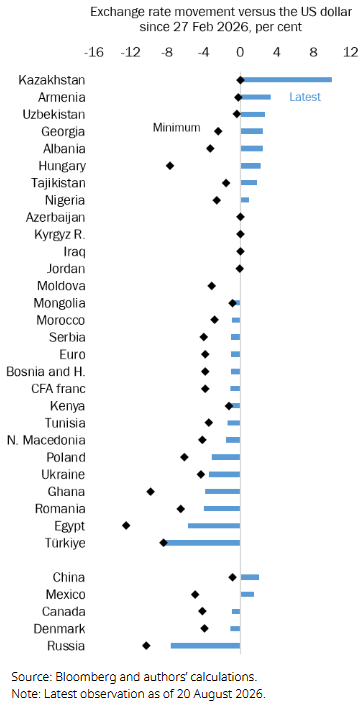
In Egypt, sovereign spreads widened by 0.3 percentage points, reflecting large government financing needs, the bank said.